
Modernizing Public Administration Case Management
A self-initiated concept project exploring case management for a public tax administration, grounded in real GovTech constraints.
Project status:
This case study is still in progress. I am actively building out the next phases of Kravbase, which will include:
System Architecture & Craft: Full design process breakdown and comprehensive design system documentation.
Advanced Workflows: Designing for edge cases, bulk triage actions, and asynchronous cross-departmental collaboration.
Governance & Compliance: Mapping out multi-tiered escalation flows and immutable version control (history logs).


The Context
Caseworkers at the Oslo Tax Office process thousands of property tax claims annually. It is a highly regulated environment where users must cross-reference complex legal documents, verify technical calculations, and make legally binding decisions with absolute precision.
The problem
The existing legacy platform hindered daily operations rather than supporting them. Caseworkers were forced to navigate a fragmented, outdated interface that lacked integration with modern technologies. This resulted in high cognitive load, redundant manual data entry, and significant workflow bottlenecks.
The objective
To replace the restrictive legacy system with a modern, centralized case management tool. The goal was to build a highly functional, accessible interface that respects data density, stays out of the user's way, and actively reduces the time-to-decision and human error rates.
Shifting from Legacy to Modern
In complex enterprise tools, every design choice must solve an operational friction point. Here is how Kravbase addresses the core failures of the old system:
❌ The Legacy System Friction
Fragmented Context: Users had to open multiple separate windows to compare a submitted tax document, internal property details, and the final decision form.
High Error Risk: Unstructured inputs and manual calculations left room for costly legal and financial errors during the decision process.
Navigation Overload: Disjointed menus made it difficult to prioritize urgent cases or see a high-level overview of the day's workload.
✅ The Kravbase Solution
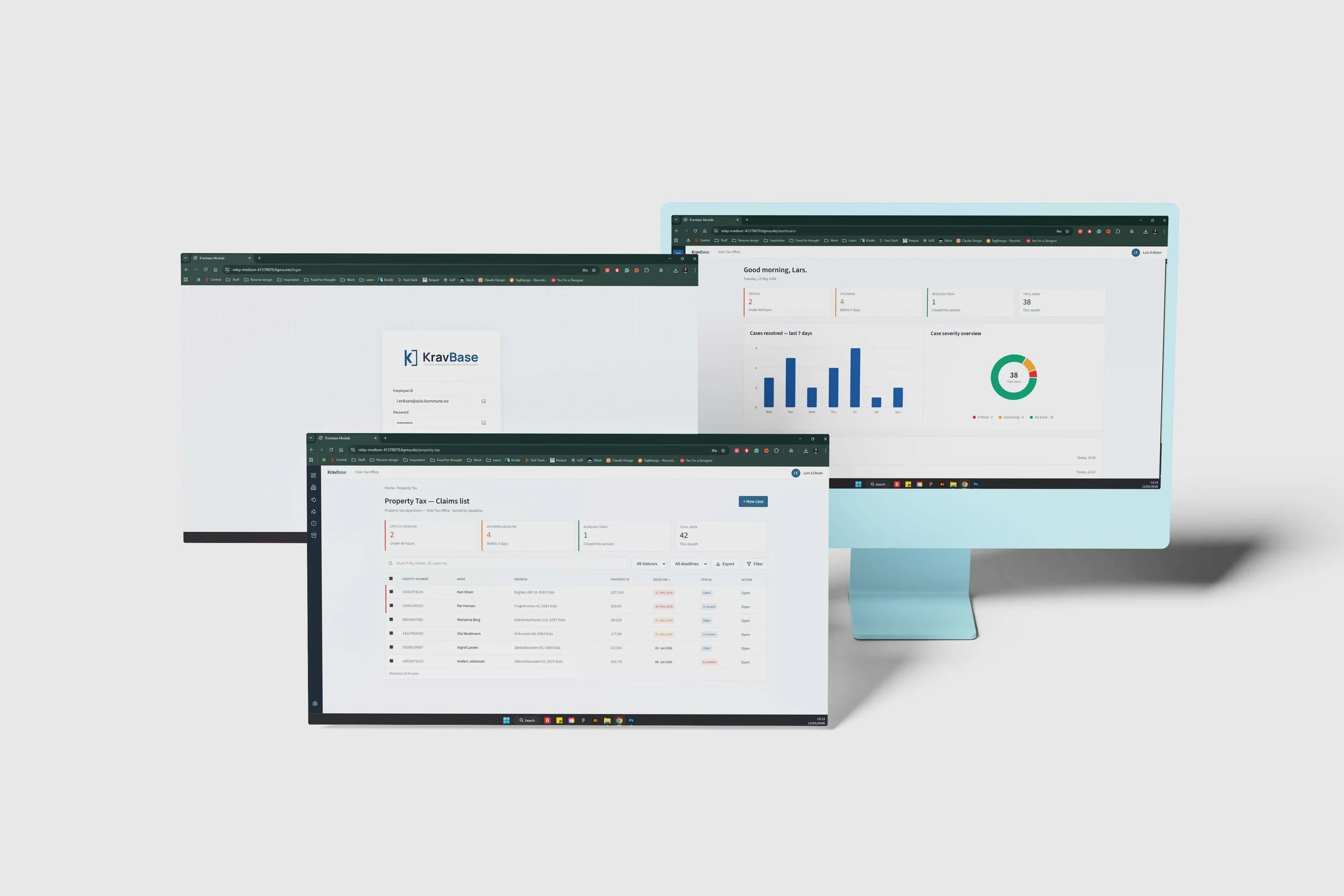
Integrated Split-Screen Context: Implemented a unified split-screen view, allowing users to reference submitted PDFs and input decisions simultaneously without relying on short-term memory.
Guardrail UX: Interaction design enforces compliance. The system requires users to explicitly review documents before enabling the "Register decision" action, acting as a built-in safety net.
Action-Oriented Dashboard: Reorganized the information architecture to surface critical deadlines and unassigned cases immediately upon login, reducing triage time.
Information Architecture
Structuring for Efficiency
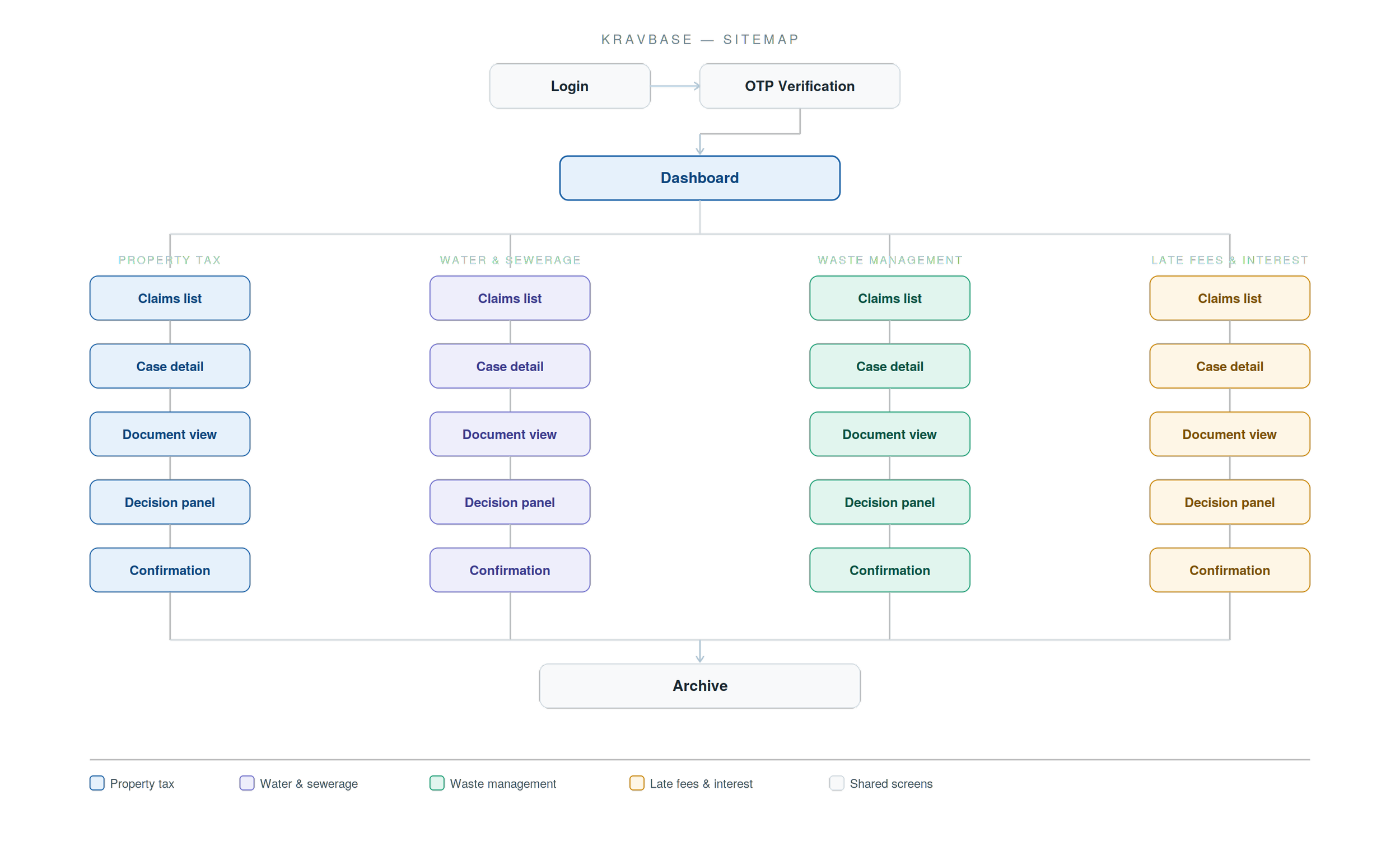
Rather than simply mapping the old system's pages, the information architecture was redesigned around the caseworker's actual daily flow. By centralizing the case details, property history, and decision registration into a single workspace, the layout drastically reduces the number of clicks required to process a standard claim.
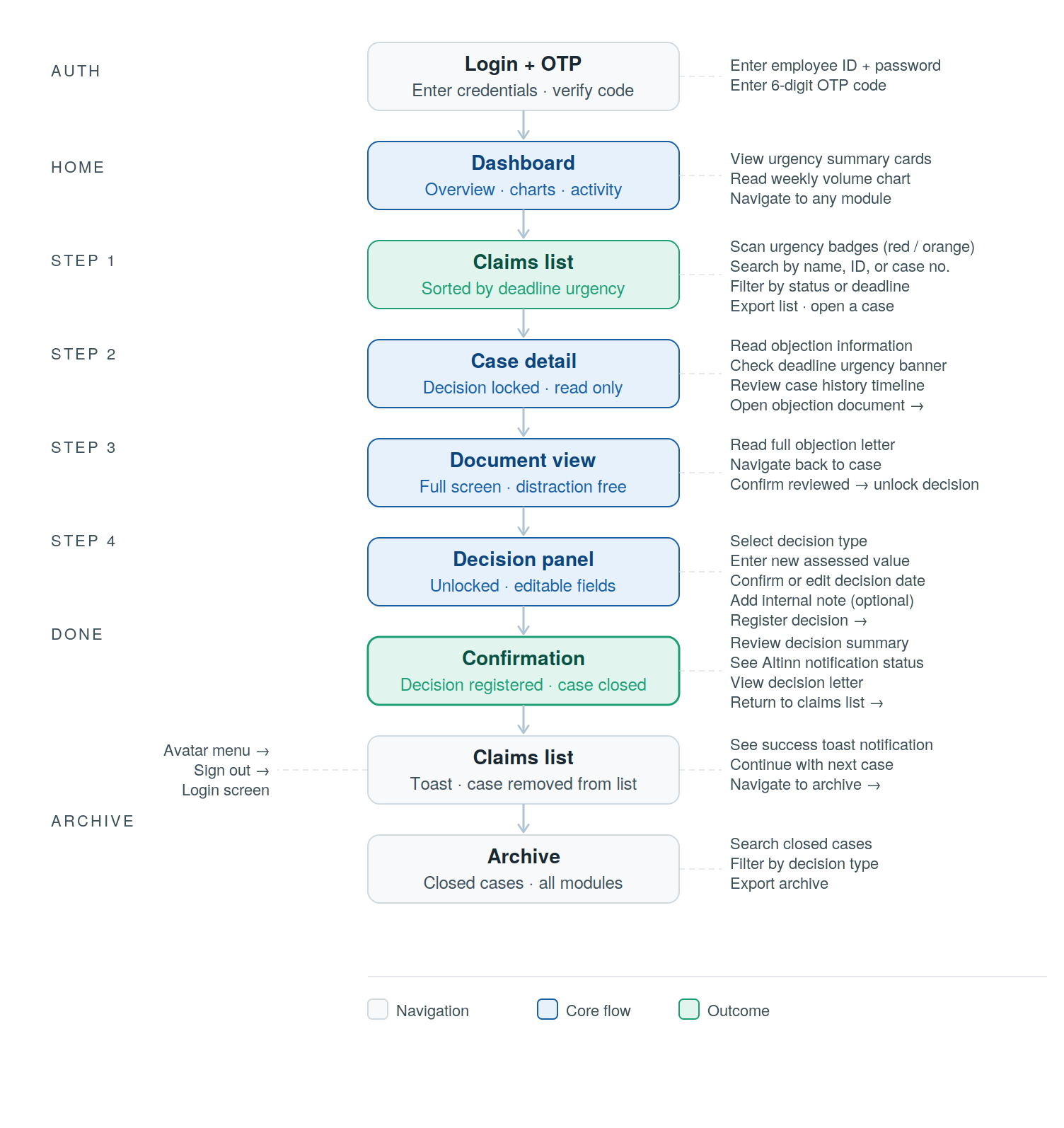
The primary flow follows a case handler from login through to decision —> eight steps covering authentication, dashboard orientation, case triage, document review, and decision registration. Each step surfaces only what's needed at that moment, with no unnecessary navigation.
The Human Cost of High Volume
A case handler at Oslo Tax Office processes 30 to 40 objections a day. These aren't simple tasks, each requires reading legal documents, cross-referencing data, applying procedural logic, and making legally binding decisions. The volume is unforgiving, and legacy systems often add steps instead of removing them.
Designing for Velocity & Context
The core design challenge wasn't just making the interface cleaner; it was reducing the distance between context and action. I designed a system that moves with the caseworker by focusing on four pillars:
Single-View Consolidation: Everything relevant to a case lives in a single view, eliminating the need to spread context across multiple tabs.
Automated Triage: Sorting by urgency is the default, removing the cognitive load of deciding where to start the day.
Context-Driven Workflows: The decision panel is positioned exactly where the document review ends, creating a seamless linear flow.
Proactive Daily Briefings: The dashboard acts as a functional briefing, telling the user exactly what their day looks like before they even open a case.
The tool doesn't make the decisions. The caseworker does. But Kravbase ensures that by the time they need to decide, everything they need is already right in front of them.
Scaling the System
This case study captures a single foundational workflow, but the reality of Oslo Kommune's operations is far more complex. Tax objections are just one node in a massive ecosystem that includes property assessments, payment disputes, and formal escalations.
Architecting for the Future
Designing the complete Kravbase system means tackling high-level structural challenges, including:
Role & Permission Models: Defining access controls for caseworkers, senior auditors, and external departments.
Intelligent Routing: Automating case assignment logic based on handler capacity and expertise.
System Scalability: Structuring an archive capable of remaining performant and accessible over decades of closed, legally binding cases.
Why I Design for Complexity
This is exactly what makes enterprise systems so compelling to me: they are never truly "finished." They are living products that evolve alongside the institutions they serve. Every edge case reveals something new about how people navigate bureaucracy. The workflow shown here isn't a conclusion, it’s the foundation.
What is Coming Next to This Case Study
Kravbase is an active, ongoing project. I will be continuously updating this portfolio piece as I build out the next phases of the product. Upcoming iterations will feature:
The Design Process: A deep dive into the research, constraints, and iterations that informed the UI.
The Kravbase Design System: Component architecture and documentation for scalable GovTech.
Advanced Flows: Mapping out complex edge cases, multi-tiered escalation flows, and bulk triage actions.
Version Control: Designing immutable history logs and asynchronous collaboration features.